
How to fully utilize Replit (fast E2E) & Claude Code (best coding model)
GitHub-Synced Dual-Environment Architecture

Problem
I love spinning up projects on Replit, especially when I’m coding on a flight. It’s wildly fast, mobile-friendly, and beautifully integrates everything I need—database, secret management, sessions, storage, testing, and deployment—into a single workspace. But there’s a severe bottleneck: you’re locked into their specific AI model ecosystem, and at $280 a year, it’s a steep price for being constrained. Meanwhile, I already pay $200 a year for my Claude subscription. I wanted to fully leverage Claude Code’s superior reasoning and iterate with different top-tier models, but I didn’t want to lose Replit’s frictionless deployment magic.
Insights
The breakthrough was realizing I didn’t have to choose between “local development” and “cloud infrastructure.” I needed to decouple the dev environment from the hosting environment. By bridging Replit’s best-in-class backend scaffolding with Claude Code’s elite local reasoning, I could build the ultimate hybrid workflow. The codebase just needed to be smart enough to dynamically adapt to wherever it was currently running.
Method
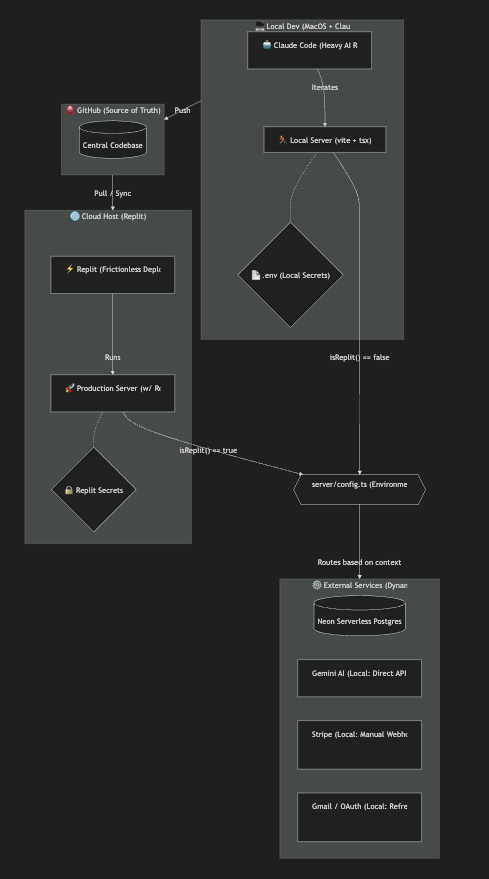
I architected a GitHub-Synced Dual-Environment setup. GitHub acts as the central nervous system, syncing my local machine (where Claude Code drives the heavy development) with Replit (which handles the live app). The secret sauce is an abstraction layer (server/config.ts) that safely detects the runtime environment on the fly using helpers like isReplit().
From there, I implemented dynamic feature gating:
Smart Dependencies: Replit-only packages (like their Vite plugins or Stripe sync) are strictly firewalled behind dynamic imports so they never crash the local build.
Service Swapping: The app routes services based on context—using OAuth2 and local .env secrets when I code locally, but seamlessly switching to Replit’s native Connector APIs and Secret Manager when deployed in the cloud.
Result
A zero-friction, highly optimized AI development loop. I’ve completely broken free from vendor lock-in while preserving the insane prototyping speed of Replit’s cloud. I can now unleash Claude Code locally to chew through complex architecture—fully maximizing the ROI on my existing subscriptions. When I’m done, I push to GitHub, and the Replit environment instantly picks it up and runs flawlessly. No manual configuration switching. Just the best of both worlds.